
Inventory Audits Made Easy with Smart Management Software
Contents
Managing inventory accurately is essential for every business that stores, sells, or distributes products. From small warehouses to large retail operations, knowing exactly what is in stock helps businesses reduce losses, avoid stockouts, and make better purchasing decisions.
However, traditional inventory audits can be time-consuming and prone to human error. This is where smart inventory management software can make a significant difference.
What Is an Inventory Audit?
An inventory audit is the process of checking and verifying the physical stock of products against the quantities recorded in a company’s inventory system.
During an audit, businesses typically check:
- Product quantities
- SKU or product codes
- Damaged or missing products
- Stock received and dispatched
- Warehouse locations
- Inventory records
- Stock discrepancies
The goal is to ensure that the physical inventory matches the digital inventory records.
Why Are Inventory Audits Important?
Regular inventory audits help businesses maintain accurate stock information. Without proper auditing, even small inventory discrepancies can lead to larger operational problems.
1. Identify Stock Discrepancies
An audit can reveal differences between the quantity recorded in the system and the actual physical stock.
For example, if the system shows 100 units but only 94 units are physically available, the business can investigate the missing six units.
2. Reduce Inventory Losses
Regular checks can help identify damaged, misplaced, expired, or missing products. This allows businesses to take corrective action quickly.
3. Prevent Stockouts
Accurate inventory data helps businesses understand when products need to be reordered, reducing the risk of running out of popular products.
4. Improve Order Management
When inventory records are accurate, businesses can process customer orders more efficiently and reduce problems caused by incorrect stock information.
How Smart Inventory Management Software Simplifies Audits
Modern inventory management software can automate many of the tasks involved in inventory auditing.
Instead of relying completely on spreadsheets and manual calculations, businesses can use software to track inventory movements and maintain centralized records.
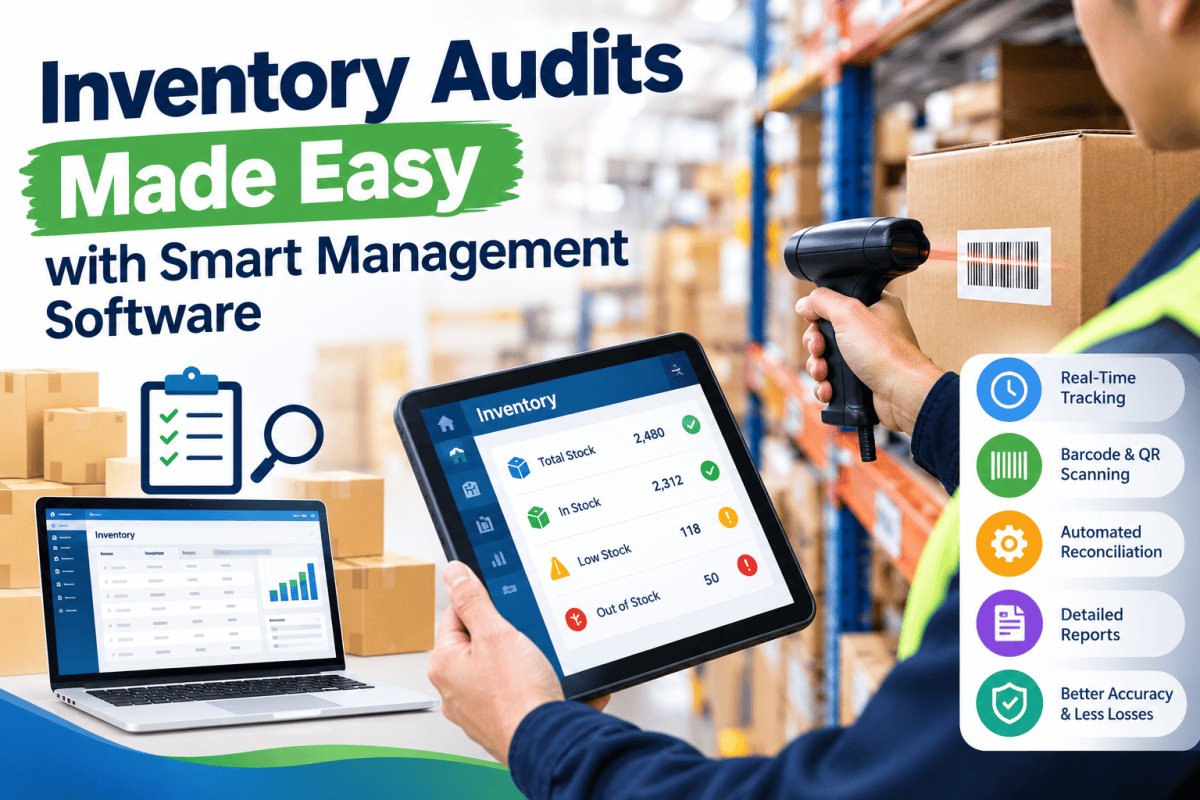
Real-Time Inventory Tracking
Smart software can provide up-to-date information about stock levels. Whenever products are received, sold, transferred, or returned, inventory records can be updated accordingly.
This gives businesses better visibility into their current stock.
Barcode and QR Code Scanning
Barcode and QR code scanning can make stock verification faster and more accurate.
Employees can scan products during an audit rather than manually entering product information. This reduces typing errors and speeds up the counting process.
Automated Stock Reconciliation
Inventory software can compare physical stock counts with system records and highlight discrepancies.
For example:
System Quantity: 250 units
Physical Quantity: 244 units
Difference: 6 units
Such information makes it easier for inventory teams to investigate and correct discrepancies.
Inventory Reports
Smart inventory systems can generate useful reports covering:
- Current stock levels
- Stock movements
- Product discrepancies
- Damaged inventory
- Low-stock products
- Purchase and sales history
- Audit results
These reports help managers understand inventory performance without manually analyzing large spreadsheets.
Manual Audits vs. Smart Inventory Audits
| Feature | Manual Audit | Smart Inventory Audit |
|---|---|---|
| Stock counting | Manual | Digital/Barcode assisted |
| Data entry | Mostly manual | Automated |
| Error risk | Higher | Lower |
| Reporting | Time-consuming | Faster |
| Stock visibility | Limited | Real-time |
| Discrepancy detection | Manual comparison | Automated comparison |
| Record management | Spreadsheets/paper | Centralized system |
Smart inventory software does not eliminate the need for physical verification, but it can make the overall auditing process faster, more organized, and easier to manage.
Best Practices for Effective Inventory Audits
Businesses can improve their auditing process by following a few simple practices.
Schedule Regular Audits
Do not wait until the end of the year to check inventory. Depending on the business, audits can be performed monthly, quarterly, or through frequent cycle counts.
Organize Inventory Properly
Clearly labeled shelves, bins, SKUs, and product locations make physical counting easier and reduce confusion.
Use Barcode Scanning
Barcode-based inventory tracking can reduce manual data entry and improve the accuracy of stock counts.
Investigate Discrepancies
When differences are found, do not simply adjust the quantity. Investigate possible causes such as damaged products, incorrect shipments, returns, duplicate entries, or misplaced inventory.
Maintain Accurate Records
Every stock movement should be recorded properly. This includes purchases, sales, returns, transfers, and adjustments.
Choosing the Right Inventory Management Software
When selecting inventory management software, businesses should consider features that match their operational requirements.
Important features may include:
- Real-time inventory tracking
- Barcode and QR code support
- Stock alerts
- Purchase and sales tracking
- Inventory reports
- Multi-location inventory management
- User access controls
- Audit history
- Stock reconciliation
- Integration with sales or accounting systems
The right solution depends on the size of the business, number of products, warehouse setup, and overall inventory workflow.
Conclusion
Inventory audits are an important part of maintaining accurate and reliable stock records. While traditional auditing methods can require significant time and manual effort, smart inventory management software can simplify the process.
With features such as real-time tracking, barcode scanning, automated reconciliation, and detailed reporting, businesses can gain better control over their inventory and identify discrepancies more efficiently.
For businesses looking to improve inventory accuracy and streamline warehouse operations, moving from manual inventory tracking to a smart digital management system can be an important step toward more efficient inventory management.
Need help with Inventory Management? BSD Infotech supplies the hardware, builds the software and integrates both.
Request a Quote