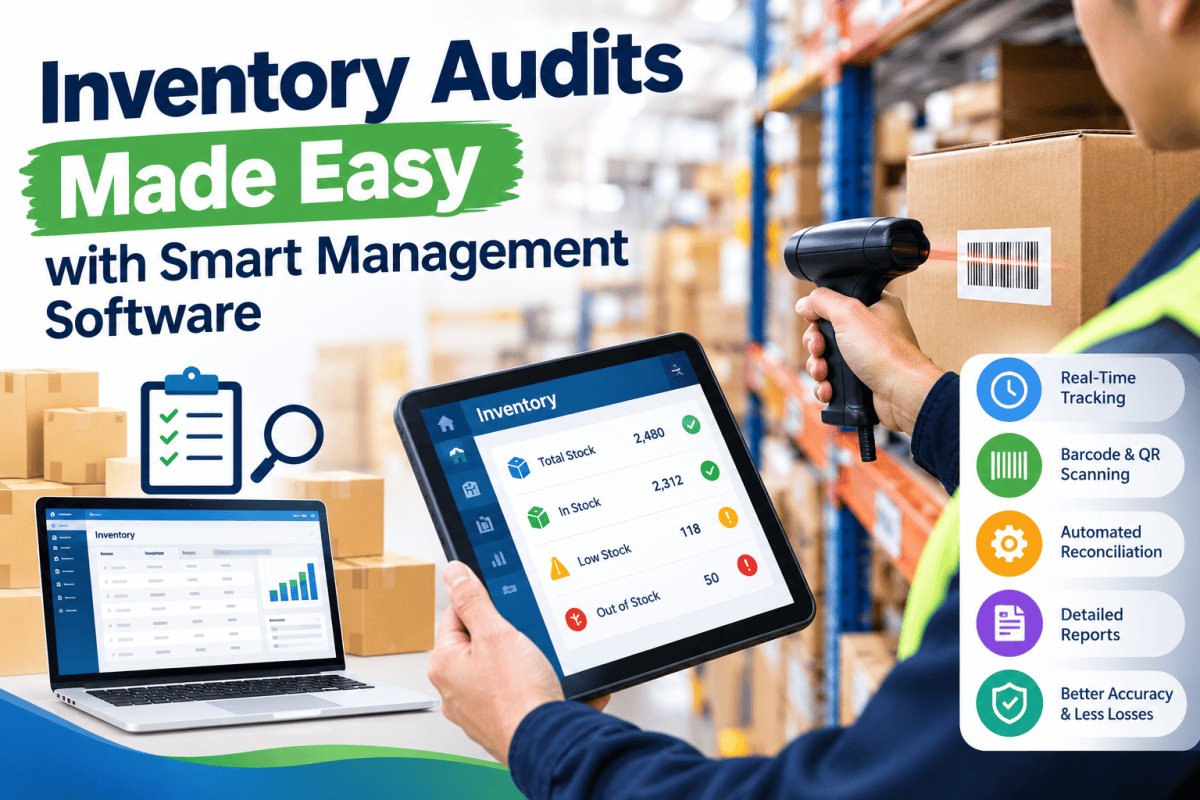
Future Trends in Smart Inventory Management
Contents
Inventory management is an important part of every business. Traditionally, companies depended on manual stock counting, spreadsheets, barcode scanning, and fixed reorder levels. While these methods can work for small operations, they can become difficult to manage as inventory volumes and customer demand increase.
Smart inventory management is changing this approach by combining technologies such as Artificial Intelligence (AI), Internet of Things (IoT), RFID, cloud computing, predictive analytics, automation, and real-time data. These technologies help businesses know what stock they have, where it is located, how quickly it is moving, and when new stock may be required.
Recent developments indicate that inventory management is moving from simple stock tracking toward predictive and increasingly automated decision-making.
What Is Smart Inventory Management?
Smart inventory management is a technology-driven approach to monitoring and controlling inventory.
Instead of waiting for employees to manually check stock, smart systems can collect information automatically from RFID readers, barcode scanners, IoT sensors, warehouse management systems, ERP systems, and sales platforms.
The collected data can then be analyzed to help businesses:
- Track inventory in real time
- Reduce stock shortages
- Avoid excess inventory
- Improve demand forecasting
- Automate stock alerts
- Improve warehouse efficiency
- Make faster purchasing decisions
Future Trends in Smart Inventory Management
1. AI-Powered Inventory Forecasting
Artificial Intelligence will play a major role in future inventory management. AI systems can analyze historical sales, current inventory, customer behavior, seasonal demand, and other business information to estimate future requirements.
Instead of simply asking “How much stock do we have?”, businesses can use AI to answer:
- How much stock will we need?
- Which products are likely to sell faster?
- When should we reorder?
- Which products may become slow-moving?
This shift from reactive inventory management to predictive inventory management can help businesses reduce both stockouts and excess inventory.
2. Real-Time Inventory Visibility
Real-time inventory visibility will become increasingly important.
RFID, IoT sensors, cloud systems, and connected warehouse equipment can provide continuous information about inventory movement. Businesses can monitor where products are located and how inventory changes across warehouses and storage areas.
This reduces the need for frequent manual stock checks and can improve inventory accuracy. Research published in 2026 highlights the growing role of IoT sensor networks, edge computing, and AI analytics in real-time warehouse monitoring.
3. Wider Use of RFID Technology
RFID technology will continue to support smart inventory systems. RFID tags can identify products and assets without requiring direct line-of-sight scanning.
Businesses can use RFID to:
- Track products
- Monitor stock movement
- Improve receiving and dispatch
- Reduce manual counting
- Locate inventory more quickly
- Improve inventory accuracy
As RFID systems become more connected with inventory software and warehouse management systems, businesses can create more automated inventory workflows.
4. Automated Warehouses
Warehouse automation is another major future trend.
Robots, automated storage and retrieval systems, autonomous mobile robots, computer vision, and other technologies can assist with storing, picking, moving, and sorting products.
The future warehouse will increasingly combine software intelligence with physical automation. Gartner identifies physical AI and multifunctional robots among important 2026 supply-chain technology trends.
5. Predictive Inventory Management
Traditional inventory systems often react after a problem occurs. Future systems will increasingly predict problems before they happen.
For example, a smart system could identify that a product is selling faster than expected and automatically recommend an earlier purchase order.
It may also detect:
- Possible stockouts
- Slow-moving products
- Unusual inventory movement
- Supplier delays
- Changing customer demand
This allows businesses to take action before inventory problems affect customers.
6. Cloud-Based Inventory Management
Cloud technology will make inventory information accessible from different locations and devices.
Businesses with multiple warehouses, stores, offices, or sales channels can use cloud-based systems to maintain a centralized view of inventory.
Managers can check stock information remotely and make faster decisions without depending on separate spreadsheets or disconnected systems.
7. Digital Twins for Inventory and Warehouses
Digital twins are virtual representations of physical operations. In a warehouse environment, a digital twin can represent inventory, storage areas, equipment, workflows, and other operational activities.
Businesses can use simulations to understand what may happen if:
- Demand suddenly increases
- Warehouse space changes
- A supplier is delayed
- Inventory levels change
- A new workflow is introduced
Digital twins are emerging as part of broader smart-warehouse and Industry 5.0 strategies.
8. Integration with ERP and WMS
Future inventory systems will become more connected.
Inventory platforms can increasingly integrate with:
- ERP software
- Warehouse Management Systems (WMS)
- Point-of-Sale systems
- E-commerce platforms
- Accounting software
- RFID systems
- IoT devices
- Logistics and transportation systems
This integration creates a connected flow of information across the business and reduces duplicate data entry.
9. AI-Driven Automation and Intelligent Agents
The next generation of AI will not only provide reports or predictions. AI-based systems are increasingly being developed to plan actions and support execution.
For example, an intelligent inventory system could identify low stock, evaluate demand, check supplier information, and recommend or initiate a replenishment workflow according to predefined business rules.
Gartner’s 2026 supply-chain trends specifically highlight agentic AI, which is designed to move beyond analysis toward planning and action.
10. Better Security and Data Governance
As inventory systems become more connected, cybersecurity will become increasingly important.
Inventory information may be connected to business operations, suppliers, customers, warehouses, and financial systems. Companies will therefore need strong access controls, secure integrations, monitoring, and reliable data governance.
Future smart inventory systems must not only be intelligent but also secure, reliable, and accountable.
11. Sustainable Inventory Management
Sustainability will also influence inventory decisions.
Smart systems can help businesses reduce:
- Overstocking
- Product waste
- Unnecessary transportation
- Excess storage
- Energy consumption
Better forecasting and inventory optimization can help companies maintain appropriate stock levels while reducing unnecessary resource usage.
Benefits of Future Smart Inventory Management
The adoption of these technologies can provide several benefits:
Improved Accuracy: Automated data collection can reduce errors caused by manual entry.
Lower Inventory Costs: Better forecasting can help businesses avoid unnecessary stock.
Faster Operations: Automation can reduce the time required for receiving, counting, picking, and dispatching.
Better Customer Service: Businesses can maintain better product availability and provide more reliable delivery.
Faster Decision-Making: Real-time dashboards and AI analytics provide useful information quickly.
Greater Visibility: Managers can monitor inventory across multiple locations from a centralized system.
Challenges to Consider
Although smart inventory management offers many advantages, businesses should also consider challenges such as implementation costs, system integration, employee training, cybersecurity, data quality, and interoperability between different technologies.
A successful smart inventory strategy should therefore focus not only on buying new technology but also on selecting the right system, maintaining accurate data, training employees, and integrating technology with existing business processes.
Conclusion
The future of inventory management is moving from manual and reactive processes to intelligent, connected, and predictive systems.
AI, RFID, IoT, cloud computing, robotics, digital twins, predictive analytics, and intelligent automation will help businesses improve inventory visibility and make better decisions.
The goal is not simply to store more products or track inventory faster. The goal is to know what is needed, when it is needed, where it is needed, and how much is needed.
Businesses that adopt smart inventory technologies strategically can improve efficiency, reduce costs, minimize stock-related problems, and build a more responsive supply chain.
Smart inventory management is therefore becoming an important foundation for the warehouse and supply chain of the future.
Frequently Asked Questions
1. What is smart inventory management?
Smart inventory management uses technologies such as AI, RFID, IoT, cloud computing, and analytics to monitor, control, and optimize inventory.
2. How does AI help inventory management?
AI can analyze inventory and sales data to forecast demand, identify potential stock shortages, detect unusual patterns, and recommend better replenishment decisions.
3. What is the role of RFID in smart inventory management?
RFID helps businesses identify and track products and assets automatically, improving inventory visibility and reducing manual counting.
4. What is the future of inventory management?
The future is expected to focus on real-time visibility, predictive analytics, AI-driven decisions, automation, connected warehouses, and intelligent replenishment.
5. Can small businesses use smart inventory systems?
Yes. Small businesses can start with basic cloud inventory software, barcode or RFID tracking, automated alerts, and gradually add advanced technologies as their requirements grow.
6. What are the main benefits of smart inventory management?
The major benefits include better inventory accuracy, reduced stockouts, lower carrying costs, faster operations, improved visibility, and better decision-making.
Need help with Inventory Management? BSD Infotech supplies the hardware, builds the software and integrates both.
Request a Quote