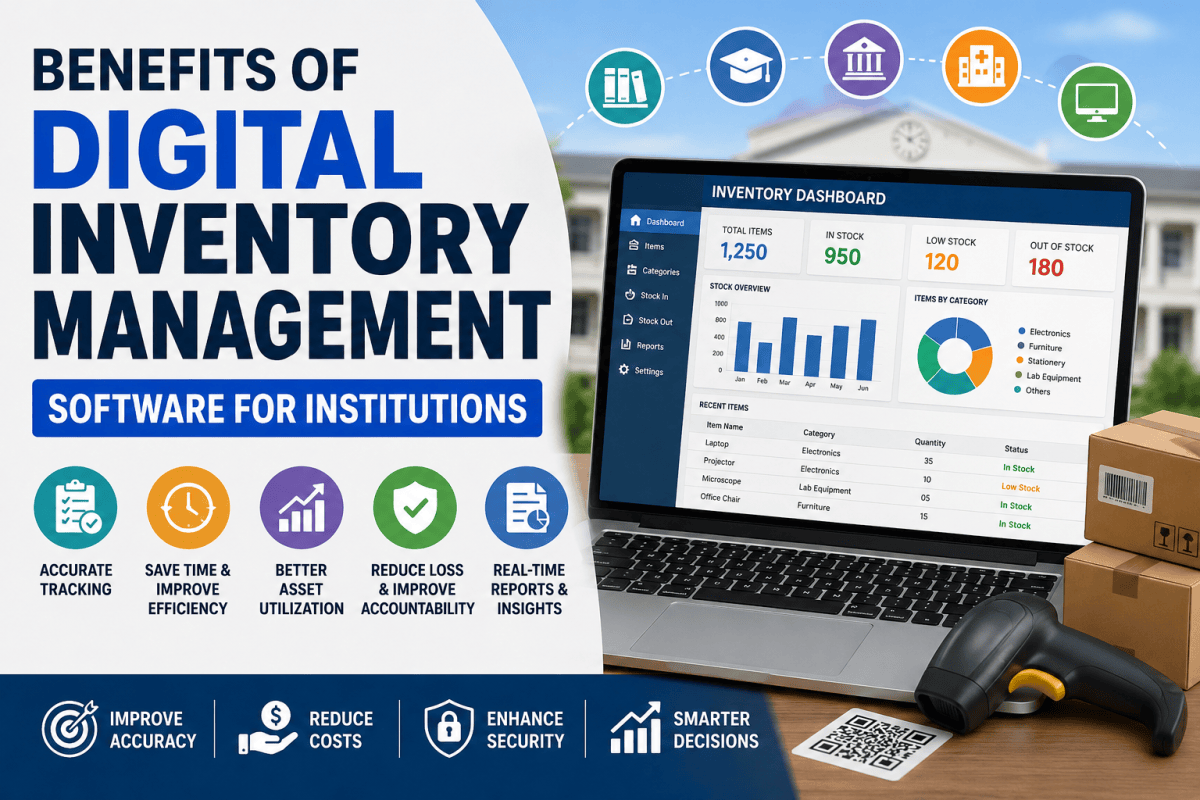
Benefits of Digital Inventory Management Software for Institutions
Contents
- What is Digital Inventory Management Software?
- 1. Accurate Inventory Tracking
- 2. Saves Time and Reduces Manual Work
- 3. Better Asset Utilization
- 4. Improved Financial Management
- 5. Real-Time Stock Monitoring
- 6. Enhanced Accountability
- 7. Reduced Asset Loss and Theft
- 8. Easier Compliance and Audits
- 9. Better Maintenance Management
- 10. Centralized Inventory Database
- 11. Data-Driven Decision Making
- 12. Scalability for Growing Institutions
- Key Features to Look for in Digital Inventory Management Software
- Why Institutions Should Go Digital
- Conclusion
Managing inventory is one of the most important responsibilities for educational institutions, healthcare facilities, government organizations, libraries, and training centers. From computers and laboratory equipment to furniture, books, and office supplies, institutions handle thousands of valuable assets every day. Keeping track of these items manually can be time-consuming, prone to errors, and difficult to manage.
This is where Digital Inventory Management Software becomes essential. It automates inventory tracking, simplifies asset management, and provides complete visibility into stock levels and asset movement. By replacing spreadsheets and paper records with a centralized digital system, institutions can improve operational efficiency while reducing costs.
In this article, we’ll explore the key benefits of digital inventory management software and why every institution should consider implementing it.
What is Digital Inventory Management Software?
Digital Inventory Management Software is a centralized system that helps institutions monitor, organize, and manage their inventory and physical assets in real time. It records every item, tracks its location, monitors usage, and generates reports for better decision-making.
The software often includes features such as:
- Barcode and QR code scanning
- Real-time inventory tracking
- Asset lifecycle management
- Automated stock updates
- Low-stock alerts
- Maintenance scheduling
- User access control
- Detailed reporting and analytics
These features make inventory management faster, more accurate, and significantly more reliable.
1. Accurate Inventory Tracking
Manual inventory tracking often leads to missing records, duplicate entries, and misplaced assets. Digital Inventory Management Software eliminates these issues by providing accurate, real-time tracking.
Every asset receives a unique identifier, allowing staff to quickly locate equipment and verify inventory details.
Benefits include:
- Reduced human errors
- Real-time inventory visibility
- Easy asset identification
- Faster inventory audits
2. Saves Time and Reduces Manual Work
Managing inventory using spreadsheets requires constant updates and manual verification. Digital software automates these repetitive tasks, allowing staff to focus on more important responsibilities.
Automation reduces:
- Manual data entry
- Inventory counting time
- Administrative workload
- Paper documentation
The result is improved productivity across departments.
3. Better Asset Utilization
Many institutions purchase new equipment simply because existing assets cannot be located. Digital inventory software provides complete visibility into available resources.
Institutions can:
- Locate unused equipment
- Share assets across departments
- Avoid duplicate purchases
- Maximize resource utilization
This helps reduce unnecessary spending.
4. Improved Financial Management
Inventory represents a significant investment. Digital Inventory Management Software helps institutions monitor asset value and optimize purchasing decisions.
Financial benefits include:
- Better budget planning
- Reduced inventory losses
- Lower replacement costs
- Accurate depreciation tracking
- Improved procurement planning
Administrators can make informed financial decisions using detailed reports.
5. Real-Time Stock Monitoring
Institutions regularly consume supplies such as stationery, laboratory materials, medical equipment, cleaning products, and maintenance items.
Real-time stock monitoring ensures:
- Current inventory levels are always visible
- Automatic low-stock notifications
- Prevention of stock shortages
- Better purchasing schedules
This minimizes disruptions in daily operations.
6. Enhanced Accountability
With digital tracking, every inventory movement is recorded.
The software tracks:
- Who checked out an asset
- Asset location
- Return dates
- Department ownership
- Maintenance history
This creates accountability and reduces asset misuse.
7. Reduced Asset Loss and Theft
Lost equipment is a common problem in large institutions. Digital Inventory Management Software significantly reduces losses through accurate asset tracking.
Features like:
- Barcode scanning
- QR code labels
- Asset history
- Check-in/check-out logs
help institutions quickly identify missing assets and improve security.
8. Easier Compliance and Audits
Educational institutions, hospitals, and government organizations often undergo inventory audits.
Digital software simplifies compliance by providing:
- Complete inventory records
- Audit trails
- Purchase history
- Maintenance logs
- Asset ownership documentation
Audits become faster, easier, and more transparent.
9. Better Maintenance Management
Equipment requires regular maintenance to ensure long-term performance.
Inventory software helps institutions:
- Schedule preventive maintenance
- Track repair history
- Receive maintenance reminders
- Monitor equipment condition
Regular maintenance extends asset lifespan and reduces repair costs.
10. Centralized Inventory Database
Instead of storing information across multiple spreadsheets, Digital Inventory Management Software keeps everything in one secure platform.
A centralized database provides:
- Easy access to inventory information
- Improved collaboration
- Consistent records
- Faster decision-making
Authorized users can access data from multiple departments while maintaining security.
11. Data-Driven Decision Making
One of the biggest advantages of digital inventory management is reporting and analytics.
Administrators can generate reports on:
- Asset utilization
- Inventory valuation
- Stock movement
- Purchase history
- Maintenance costs
- Department-wise inventory
These insights help institutions optimize inventory management and improve planning.
12. Scalability for Growing Institutions
As institutions grow, inventory management becomes increasingly complex.
Digital Inventory Management Software easily scales to support:
- Multiple campuses
- Additional departments
- Thousands of assets
- Multiple storage locations
- Growing user bases
The software grows with the organization without increasing administrative complexity.
Key Features to Look for in Digital Inventory Management Software
Before selecting software, institutions should consider features such as:
- Cloud-based access
- Barcode and QR code support
- Mobile application compatibility
- Role-based user permissions
- Automated alerts
- Asset lifecycle management
- Reporting dashboards
- Integration with ERP or accounting systems
- Data backup and security
- Multi-location inventory support
Choosing software with these capabilities ensures long-term efficiency.
Why Institutions Should Go Digital
Traditional inventory management methods no longer meet the needs of modern institutions. Digital Inventory Management Software provides greater accuracy, improved efficiency, enhanced security, and better financial control.
Whether managing classrooms, laboratories, libraries, hospitals, or administrative offices, digital inventory systems help institutions save time, reduce costs, and improve resource utilization.
Investing in a modern inventory management solution is not just about technology—it’s about creating a smarter, more organized institution.
Conclusion
Digital Inventory Management Software has become an essential tool for institutions seeking efficient and reliable inventory control. By automating tracking, improving accountability, reducing losses, and providing real-time insights, it transforms how organizations manage their valuable assets.
As institutions continue to expand and modernize, adopting digital inventory management is a strategic investment that enhances productivity, supports better decision-making, and ensures long-term operational success.
Need help with Inventory Management? BSD Infotech supplies the hardware, builds the software and integrates both.
Request a Quote