
Digital Complaint Tracking for Government Organizations: Improving Transparency and Citizen Satisfaction
Contents
- What Is Digital Complaint Tracking?
- Why Government Organizations Need Digital Complaint Tracking
- Key Features of a Digital Complaint Tracking System
- Benefits of Digital Complaint Tracking for Government Organizations
- How the Digital Complaint Tracking Process Works
- The Role of Automation and AI
- Challenges in Implementing Digital Complaint Tracking
- Best Practices for Government Organizations
- The Future of Digital Grievance Redressal
- Conclusion
In today’s digital era, citizens expect government services to be accessible, transparent, and responsive. One of the most important aspects of good governance is the ability to address public complaints efficiently. However, traditional complaint-handling processes involving paper forms, manual registers, phone calls, and multiple departmental transfers can often lead to delays, lost records, and poor communication.
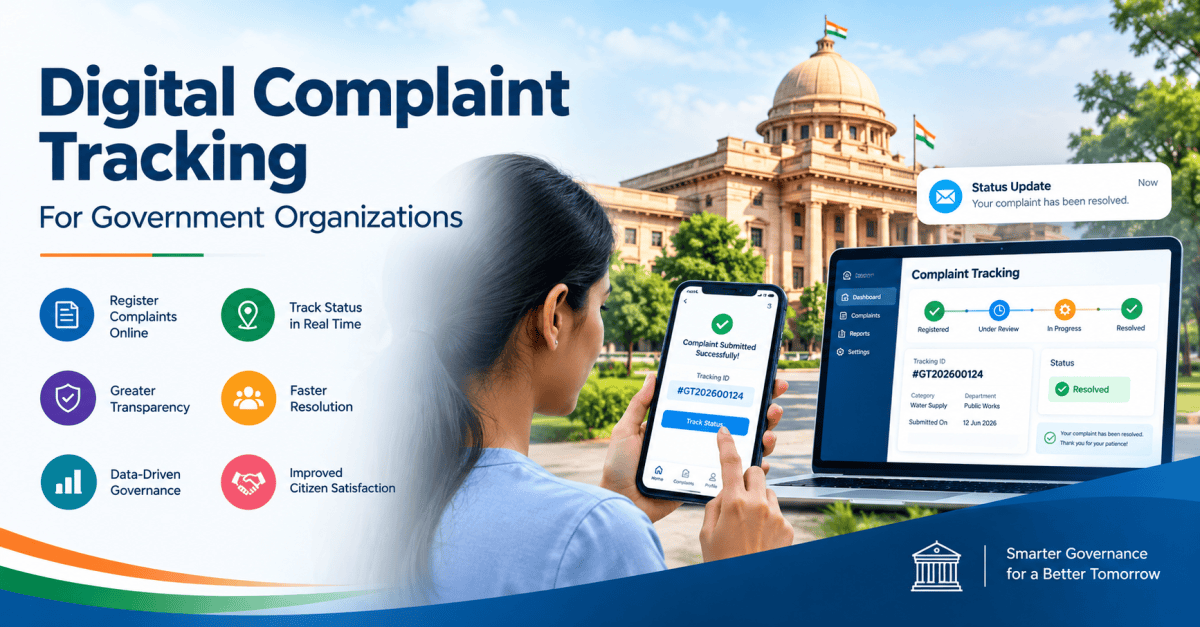
A Digital Complaint Tracking System helps government organizations modernize the grievance redressal process by allowing citizens to register, monitor, and follow up on their complaints through a centralized digital platform.
By digitizing complaint management, government departments can improve accountability, reduce response time, and build stronger trust with citizens.
What Is Digital Complaint Tracking?
Digital Complaint Tracking is an automated system designed to manage the complete lifecycle of a citizen complaint. Instead of manually recording complaints, government organizations can use a centralized portal or application where complaints are digitally registered, categorized, assigned, monitored, and resolved.
The system allows citizens to:
- Register complaints online
- Receive a unique complaint or ticket ID
- Upload supporting documents or images
- Track complaint status in real time
- Receive SMS or email notifications
- Send reminders for unresolved complaints
- Provide feedback after resolution
Government officials can use the same platform to assign complaints to the appropriate department, monitor pending cases, and evaluate departmental performance.
India already uses digital grievance platforms such as CPGRAMS and state-level grievance portals, demonstrating the importance of centralized complaint registration, tracking, reminders, feedback, and transparent monitoring in public service delivery.
Why Government Organizations Need Digital Complaint Tracking
Government organizations handle a large number of complaints related to public services every day. These may include issues related to:
- Water supply
- Electricity
- Roads and infrastructure
- Sanitation
- Public transportation
- Municipal services
- Healthcare services
- Education
- Government schemes
- Social welfare programs
- Property and land-related services
Managing such complaints manually can be difficult, especially when multiple departments and officers are involved.
A digital tracking system creates a structured workflow where every complaint is recorded and monitored from submission to resolution.
Key Features of a Digital Complaint Tracking System
1. Online Complaint Registration
Citizens can submit complaints through a web portal, mobile application, kiosk, or other digital channels. The system records important details such as:
- Name of the citizen
- Contact information
- Complaint category
- Location
- Description of the issue
- Supporting documents or photographs
This eliminates the dependency on physical paperwork and makes complaint registration more convenient.
2. Unique Complaint ID
Once a complaint is registered, the system generates a unique complaint or reference number.
Citizens can use this ID to track the progress of their complaint without repeatedly visiting government offices.
A unique tracking ID also helps government officials quickly access the complete complaint history.
3. Automatic Complaint Categorization
Digital systems can categorize complaints based on department, service type, location, or priority.
For example:
- Road damage → Public Works Department
- Water leakage → Water Department
- Garbage collection → Municipal Corporation
- Streetlight issue → Electrical Department
Automatic categorization ensures that complaints are directed to the appropriate department faster.
4. Automated Assignment and Escalation
Once registered, complaints can automatically be assigned to responsible officers.
If a complaint remains unresolved beyond the defined time limit, the system can automatically escalate it to higher authorities.
This helps prevent complaints from being ignored or unnecessarily delayed.
5. Real-Time Complaint Status Tracking
Transparency is one of the biggest benefits of digital complaint management.
Citizens can check whether their complaint is:
- Registered
- Under review
- Assigned to an officer
- In progress
- Resolved
- Closed
Real-time tracking reduces uncertainty and improves communication between citizens and government departments.
6. SMS and Email Notifications
Automated notifications can keep citizens informed at every stage.
For example, notifications can be sent when:
- A complaint is successfully registered
- The complaint is assigned to an अधिकारी
- Additional information is required
- The complaint status changes
- The complaint is resolved
This reduces the need for citizens to repeatedly contact government offices for updates.
7. Dashboard and Analytics
Government administrators can access centralized dashboards showing important information such as:
- Total complaints received
- Resolved complaints
- Pending complaints
- Overdue complaints
- Department-wise performance
- Average resolution time
- Frequently reported issues
These insights help authorities identify operational problems and improve service delivery.
Modern public grievance systems increasingly use centralized dashboards, role-based access, automated routing, analytics, and monitoring to improve accountability and resolution quality.
Benefits of Digital Complaint Tracking for Government Organizations
Improved Transparency
Every complaint is digitally recorded and can be tracked throughout its lifecycle. Citizens have better visibility into the actions taken by government departments.
Faster Complaint Resolution
Automated routing and assignment reduce delays caused by manual communication between departments.
Complaints can quickly reach the responsible officer, improving response and resolution time.
Increased Accountability
Digital records make it easier to identify which department or officer is responsible for handling a complaint.
Authorities can monitor pending cases and take action when complaints remain unresolved.
Better Citizen Experience
Citizens no longer need to make repeated visits to government offices.
They can register complaints, upload documents, track progress, and receive updates digitally.
Centralized Complaint Management
Instead of maintaining separate records across multiple departments, organizations can manage complaints through a single centralized platform.
This improves coordination and reduces duplication.
Data-Driven Decision Making
Complaint data can reveal recurring public issues.
For example, if a particular area repeatedly reports water supply problems, authorities can identify the issue and take preventive action.
How the Digital Complaint Tracking Process Works
A typical digital complaint tracking workflow follows these steps:
Step 1: Complaint Registration
The citizen submits a complaint through a portal, mobile application, or other digital channel.
Step 2: Complaint ID Generation
The system generates a unique reference number.
Step 3: Categorization
The complaint is categorized according to the service or department.
Step 4: Assignment
The complaint is automatically assigned to the responsible officer or department.
Step 5: Investigation and Action
The concerned department investigates the issue and takes appropriate action.
Step 6: Status Updates
The system updates the complaint status and informs the citizen.
Step 7: Resolution
Once the issue is resolved, the complaint is marked as completed.
Step 8: Citizen Feedback
The citizen can provide feedback regarding the quality of resolution.
This structured process ensures that complaints do not get lost and remain traceable until closure.
The Role of Automation and AI
Emerging technologies are making digital complaint tracking even more efficient.
Artificial Intelligence can help government organizations:
- Automatically categorize complaints
- Identify duplicate complaints
- Detect urgent issues
- Route complaints to the correct department
- Analyze complaint patterns
- Predict recurring service problems
- Provide chatbot-based assistance
AI-powered analytics can help authorities move from simply resolving complaints to identifying the root causes of recurring public issues.
Recent government initiatives around digital grievance redressal have also highlighted AI-based categorization, intelligent routing, automated escalation, multilingual support, analytics, and citizen feedback as important capabilities for improving public service delivery.
Challenges in Implementing Digital Complaint Tracking
While digital systems offer significant benefits, government organizations must address certain challenges.
Digital Accessibility
Not every citizen may have access to smartphones or reliable internet connectivity. Government systems should therefore support multiple channels such as web portals, mobile applications, call centers, and physical assistance centers.
Data Security
Citizen complaints may contain personal or sensitive information. Strong cybersecurity measures and role-based access controls are essential.
Interdepartmental Coordination
Government organizations often involve multiple departments. A successful system should provide seamless communication and clear responsibility at every level.
User Awareness
Citizens must be informed about how to register and track complaints through the digital platform.
Simple and user-friendly interfaces can significantly improve adoption.
Best Practices for Government Organizations
To successfully implement a Digital Complaint Tracking System, government organizations should focus on:
- Simple and user-friendly complaint registration
- Multi-language support
- Mobile-friendly access
- Unique complaint tracking IDs
- Automated department assignment
- Defined resolution timelines
- Automatic escalation of overdue complaints
- SMS and email notifications
- Role-based access for government officials
- Centralized monitoring dashboards
- Citizen feedback mechanisms
- Strong data security and privacy controls
The Future of Digital Grievance Redressal
The future of government complaint management will be more intelligent, connected, and citizen-centric.
Advanced systems may integrate technologies such as:
- Artificial Intelligence
- Machine Learning
- Chatbots
- Voice-based complaint registration
- Mobile applications
- Geographic Information Systems (GIS)
- Predictive analytics
- Automated workflow systems
Instead of simply responding to complaints, governments will increasingly use complaint data to identify infrastructure gaps, improve public services, and prevent recurring problems.
A digital complaint tracking platform can therefore become an important part of smart governance and digital transformation.
Conclusion
Digital Complaint Tracking is transforming the way government organizations manage citizen grievances. By replacing manual processes with automated workflows, centralized dashboards, real-time tracking, and digital communication, government departments can deliver faster and more transparent services.
An effective system ensures that every complaint is recorded, assigned, monitored, and resolved within a defined timeframe. It also gives citizens greater visibility and confidence in the grievance redressal process.
As governments continue to adopt digital transformation initiatives, intelligent complaint tracking systems will play a vital role in creating more accountable, responsive, and citizen-focused public services.
Digital complaint tracking is not just about managing grievances—it is about building trust between citizens and government through transparency, accountability, and timely action.
Need help with Complaint Management? BSD Infotech supplies the hardware, builds the software and integrates both.
Request a Quote