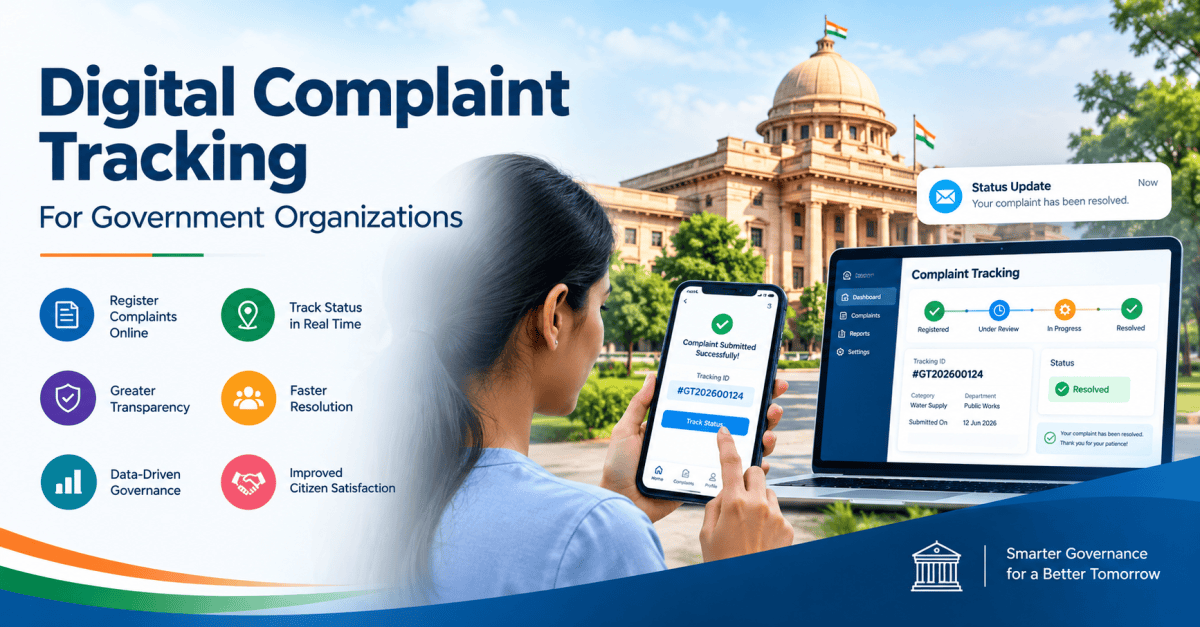
Benefits of Self-Service Complaint Portals
Contents
- What Is a Self-Service Complaint Portal?
- 1. Convenient and Easy Complaint Registration
- 2. Faster Complaint Resolution
- 3. Real-Time Complaint Tracking
- 4. Reduced Workload for Support Teams
- 5. Better Transparency and Accountability
- 6. Centralized Complaint Management
- 7. Improved User Satisfaction
- 8. Valuable Insights Through Reports and Analytics
- 9. Better Record Keeping
- 10. Scalable for Growing Organizations
- Conclusion
In today’s fast-paced environment, customers, employees, students, residents, and other users expect quick and convenient solutions to their problems. Traditional complaint management methods, such as phone calls, emails, or manual registers, can be slow and difficult to track. A self-service complaint portal provides a centralized digital platform where users can register, monitor, and manage complaints conveniently.
What Is a Self-Service Complaint Portal?
A self-service complaint portal is an online system that allows users to submit complaints or service requests without depending entirely on staff assistance. Users can describe their issue, attach relevant documents or images, and track the progress of their complaint from submission to resolution.
The system also helps organizations organize complaints, assign them to the appropriate department, monitor resolution timelines, and maintain a complete record of every request.
1. Convenient and Easy Complaint Registration
One of the biggest benefits of a self-service complaint portal is convenience. Users can submit complaints anytime and from anywhere using a computer or mobile device.
Instead of visiting an office, making repeated phone calls, or sending multiple emails, users can simply log in to the portal, select the relevant complaint category, and submit their issue.
2. Faster Complaint Resolution
A centralized digital system helps organizations route complaints directly to the responsible department or employee. This reduces delays caused by manual communication and ensures that issues reach the right person quickly.
Automated notifications and reminders can also help teams respond faster and prevent complaints from being overlooked.
3. Real-Time Complaint Tracking
Users often feel frustrated when they do not know what is happening with their complaint. A self-service portal provides transparency by allowing users to track the status of their request.
For example, users may be able to see whether a complaint is:
- Submitted
- Under Review
- Assigned
- In Progress
- Resolved
- Closed
This improves communication and reduces the need for users to repeatedly contact the support team for updates.
4. Reduced Workload for Support Teams
Manual complaint handling requires employees to answer calls, respond to emails, update records, and provide status updates. A self-service portal automates many of these routine activities.
Users can independently submit complaints and check their status, allowing support teams to focus more on resolving issues rather than managing repetitive queries.
5. Better Transparency and Accountability
Every complaint submitted through the portal can be recorded with important details such as the submission date, complaint category, assigned employee, updates, and resolution time.
This creates greater accountability because organizations can identify who is responsible for handling each complaint and monitor whether it is resolved within the expected timeframe.
6. Centralized Complaint Management
Managing complaints through multiple channels can create confusion and increase the risk of missed requests. A self-service portal brings all complaints together in one centralized system.
Administrators can easily search, filter, categorize, prioritize, and manage complaints from a single dashboard. This improves organization and makes complaint management more efficient.
7. Improved User Satisfaction
A quick and transparent complaint resolution process can significantly improve user satisfaction. When users can easily report issues and receive regular updates, they feel that their concerns are being taken seriously.
A positive support experience can help organizations build stronger relationships with customers, employees, students, or other stakeholders.
8. Valuable Insights Through Reports and Analytics
Complaint data can provide valuable insights into recurring problems. Organizations can analyze trends to identify common issues, frequently affected departments, and areas where service improvements are needed.
For example, if multiple users repeatedly report the same issue, management can investigate the root cause and implement a long-term solution.
9. Better Record Keeping
A digital complaint portal maintains a complete history of complaints and their resolutions. This eliminates the need to manage paper records or search through multiple email conversations.
Historical records can also help organizations review previous cases, measure service performance, and maintain proper documentation.
10. Scalable for Growing Organizations
As an organization grows, the number of complaints and service requests may also increase. A self-service complaint portal can help manage this growing workload more efficiently.
The system can support multiple departments, users, complaint categories, and workflows, making it suitable for schools, colleges, corporate offices, residential communities, hospitals, government organizations, and other institutions.
Conclusion
A self-service complaint portal makes complaint management faster, more transparent, and more organized. By allowing users to register and track complaints independently, organizations can reduce administrative workload while improving response times and user satisfaction.
With centralized management, automated workflows, real-time tracking, and actionable analytics, a self-service complaint portal helps organizations transform complaint handling from a manual process into an efficient and user-friendly digital experience.
Need help with Complaint Management? BSD Infotech supplies the hardware, builds the software and integrates both.
Request a Quote