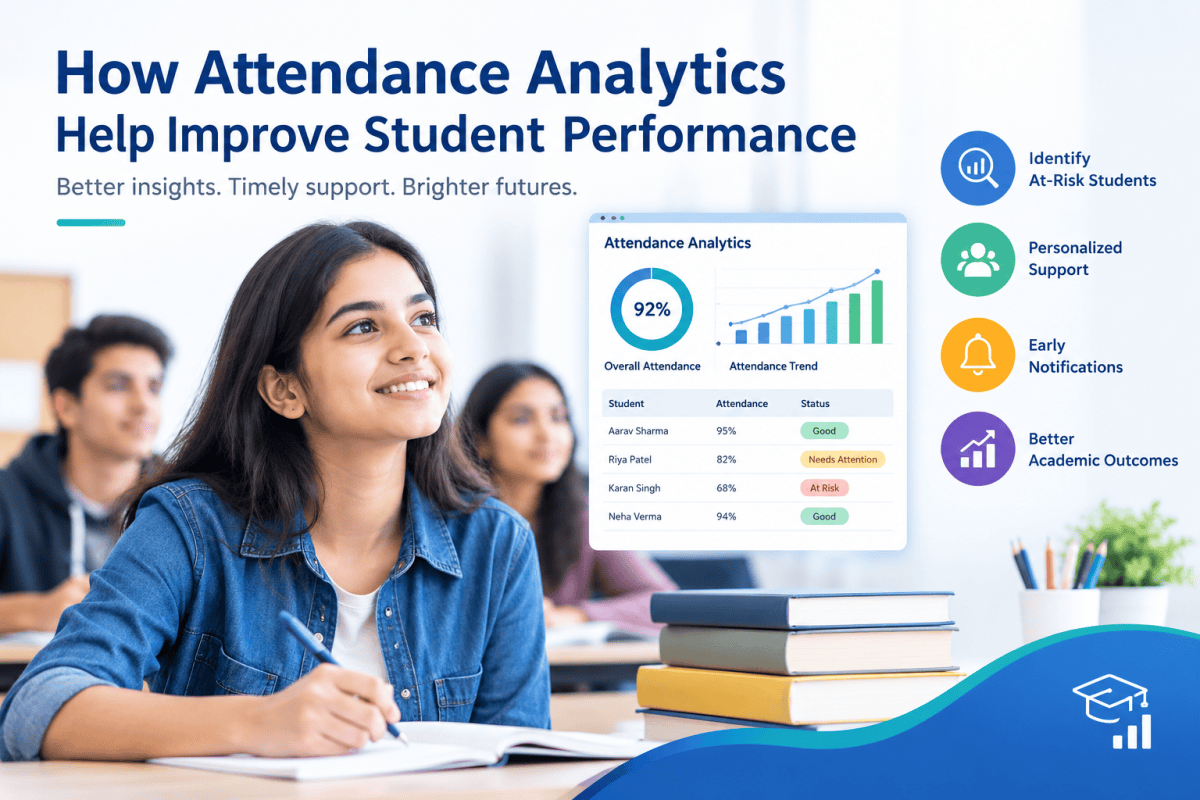
How Attendance Analytics Help Improve Student Performance
Contents
- What Is Attendance Analytics?
- Why Is Attendance Important for Student Performance?
- 1. Identifies Students Who May Need Support
- 2. Helps Teachers Understand Attendance Patterns
- 3. Supports Personalized Student Guidance
- 4. Provides Early-Warning Alerts
- 5. Improves Communication With Parents
- 6. Helps Monitor Subject-Wise Attendance
- 7. Helps Administrators Make Data-Driven Decisions
- 8. Helps Track Changes Over Time
- 9. Helps Evaluate Student Interventions
- 10. Can Help Reduce Frequent Absenteeism
- 11. Connects Attendance With Academic Performance
- 12. Reduces Manual Attendance Management
- How Does Attendance Analytics Work?
- Benefits of Attendance Analytics for Educational Institutions
- Role of Digital Attendance Management in Student Success
- Best Practices for Using Attendance Analytics
- Conclusion
- Frequently Asked Questions (FAQs)
In today’s education environment, student attendance is more than just a record of presence and absence. Regular attendance can provide valuable insights into student engagement, participation, and academic progress. With the help of digital attendance management and analytics, schools, colleges, universities, and educational institutions can turn attendance data into actionable information.
Attendance analytics helps educators identify attendance trends, detect students who may need additional support, and make data-driven decisions. When attendance information is reviewed together with academic performance and other engagement indicators, institutions can develop a better understanding of student needs.
What Is Attendance Analytics?
Attendance analytics is the process of collecting, organizing, and analysing student attendance data to identify useful patterns and trends.
A traditional attendance register may only show whether a student was present or absent. An attendance analytics system can provide much more information, such as:
- Student-wise attendance percentage
- Class-wise attendance
- Subject-wise attendance
- Frequent absence patterns
- Late arrival trends
- Attendance changes over time
- Students with low attendance
- Attendance comparisons between classes or departments
- Early-warning indicators
These insights help teachers and administrators take action rather than simply maintaining attendance records.
Why Is Attendance Important for Student Performance?
Regular classroom attendance gives students more opportunities to participate in lessons, interact with teachers, complete classroom activities, and stay connected with their course content.
A decline in attendance may sometimes be an early indication that a student is facing academic, personal, transportation, engagement, or other challenges.
By monitoring attendance regularly, institutions can identify these changes earlier and determine whether a student needs additional support.
1. Identifies Students Who May Need Support
One of the most important benefits of attendance analytics is early identification.
For example, a student whose attendance gradually falls from 90% to 80% and then 70% may require attention. Instead of waiting until the end of the semester, teachers can review the student’s attendance trend and take appropriate action.
Possible actions include:
- Speaking with the student
- Contacting parents or guardians
- Understanding the reason for absence
- Providing academic guidance
- Offering additional learning support
- Referring the student to appropriate institutional support
Early action can help prevent a temporary attendance problem from becoming a larger academic challenge.
2. Helps Teachers Understand Attendance Patterns
Attendance analytics makes it easier to identify patterns that may not be obvious from manual registers.
For example, an institution may discover that a student is frequently absent:
- On a particular day of the week
- During a particular subject
- Before examinations
- After holidays
- During specific periods of the academic year
Understanding these patterns can help teachers and administrators investigate the underlying reasons and provide appropriate support.
3. Supports Personalized Student Guidance
Every student has different academic requirements and circumstances. Attendance analytics can help educators identify students who need different types of attention.
For example:
Low attendance + declining grades
→ Student may require academic intervention.
Low attendance + stable grades
→ Attendance issue may require monitoring and discussion.
Sudden attendance decline
→ Teacher may need to investigate the reason for the change.
This allows institutions to provide more targeted student support instead of applying the same approach to every student.
4. Provides Early-Warning Alerts
Digital attendance systems can be configured to identify students whose attendance falls below a predefined level.
For example:
Attendance below required level → Warning
Repeated absences → Follow-up Required
Continuous attendance decline → Review Required
Such alerts help teachers and administrators focus their attention on students who may need immediate support.
5. Improves Communication With Parents
Attendance analytics can make communication with parents more clear and informative.
Instead of simply saying that a student’s attendance is low, institutions can provide information such as:
- Current attendance percentage
- Number of classes missed
- Subject-wise attendance
- Attendance trend
- Dates of absence
This gives parents a better understanding of the student’s attendance situation and helps them work with the institution to address concerns.
6. Helps Monitor Subject-Wise Attendance
Overall attendance can sometimes hide problems in individual subjects.
For example, a student may have 82% overall attendance, but attendance in one important subject may be only 65%.
Subject-wise analytics can help teachers identify such issues and take appropriate action before the student falls behind.
7. Helps Administrators Make Data-Driven Decisions
Attendance analytics is also valuable for school and college administrators.
Administrators can analyse attendance across:
- Classes
- Courses
- Departments
- Subjects
- Semesters
- Academic years
This information can help institutions understand broader attendance trends and identify areas where additional attention may be required.
8. Helps Track Changes Over Time
A single attendance percentage provides limited information. Attendance trends over time can provide much greater insight.
For example:
January: 91%
February: 87%
March: 79%
April: 72%
This downward trend may indicate that the student needs attention even before attendance reaches a critical level.
Trend analysis therefore helps institutions move from reactive attendance management to proactive student support.
9. Helps Evaluate Student Interventions
Attendance analytics can also be used to monitor whether an intervention is working.
For example:
- A student is identified with declining attendance.
- The teacher discusses the issue with the student.
- Additional academic support is provided.
- Attendance is monitored over the following weeks.
- The institution compares attendance before and after the intervention.
If attendance improves, the institution can determine that the intervention may have been helpful.
This creates a simple process:
Identify → Intervene → Monitor → Evaluate
10. Can Help Reduce Frequent Absenteeism
Frequent absence can gradually affect a student’s ability to keep up with classroom learning.
Attendance analytics allows institutions to identify repeated absences and declining attendance earlier. Teachers and administrators can then communicate with students and parents and understand the reasons behind the absences.
The purpose is not simply to penalize students for missing classes, but to understand the reasons for absenteeism and provide appropriate support.
11. Connects Attendance With Academic Performance
Attendance data becomes even more useful when it is considered alongside academic information.
Institutions can compare:
Attendance + Grades + Assessments + Student Engagement
For example, if a student’s attendance decreases at the same time as their assessment scores decline, educators may have a stronger reason to review the student’s academic situation.
However, attendance should not be treated as the only indicator of student performance. It should be considered as one part of a broader student-success strategy.
12. Reduces Manual Attendance Management
Digital attendance systems can reduce the time teachers and administrative staff spend maintaining manual registers and preparing reports.
Depending on the system, attendance can be recorded using technologies such as:
- Biometric attendance
- RFID cards
- Smart cards
- QR codes
- Mobile applications
- Web-based attendance systems
Once attendance is recorded digitally, reports and analytics can be generated more efficiently.
How Does Attendance Analytics Work?
A typical attendance analytics process can include the following steps:
Step 1: Attendance Collection
Student attendance is recorded using a digital attendance system or other approved method.
Step 2: Data Storage
Attendance information is securely stored and organized according to students, classes, subjects, departments, and dates.
Step 3: Data Analysis
The system calculates attendance percentages and identifies trends, frequent absences, and other patterns.
Step 4: Dashboard and Reports
Teachers and administrators can view attendance information through dashboards and reports.
Step 5: Alerts
Students with attendance concerns can be highlighted according to institutional rules or predefined thresholds.
Step 6: Intervention
Teachers or student-support teams can review the situation and provide appropriate guidance.
Step 7: Progress Monitoring
Attendance can continue to be monitored to determine whether the student’s situation improves.
Benefits of Attendance Analytics for Educational Institutions
Implementing attendance analytics can provide several benefits:
- Early identification of attendance concerns
- Better student engagement monitoring
- Timely intervention
- Improved parent communication
- Subject-wise attendance tracking
- Reduced manual work
- Faster report generation
- Better administrative visibility
- Data-driven decision-making
- Improved student-support planning
Role of Digital Attendance Management in Student Success
A digital attendance management system provides the foundation for effective attendance analytics.
Automated attendance collection makes attendance information easier to record, access, organize, and analyse. When this data is combined with academic and engagement information, educational institutions can gain a more complete picture of student progress.
However, attendance analytics should support human decision-making rather than replace it. A low attendance percentage does not automatically explain why a student is absent. Teachers and administrators should consider the individual circumstances of each student before deciding on an intervention.
Best Practices for Using Attendance Analytics
Educational institutions can get better results from attendance analytics by following a few best practices:
1. Monitor Attendance Regularly
Do not wait until the end of the semester to review attendance. Regular monitoring makes it easier to identify changes early.
2. Focus on Trends
A sudden or continuous decline can be more informative than a single attendance percentage.
3. Combine Multiple Indicators
Where appropriate, review attendance together with academic performance and other relevant engagement indicators.
4. Take Timely Action
When a student is identified as needing support, appropriate action should be taken as early as possible.
5. Maintain Data Privacy
Student attendance and academic information should be handled responsibly and accessed only by authorized users.
6. Use Analytics for Support
The purpose of attendance analytics should be to help students succeed, not simply to generate reports or monitor attendance numbers.
Conclusion
Attendance analytics can transform traditional attendance records into meaningful insights that help educational institutions better support students.
By identifying attendance trends, recognizing frequent absences, generating early warnings, monitoring subject-wise attendance, and connecting attendance information with academic indicators, schools and colleges can take proactive steps to support student success.
The ultimate goal of attendance analytics is not simply to increase attendance. It is to understand student engagement, identify challenges early, provide timely support, and create better opportunities for students to achieve their academic goals.
As educational institutions continue adopting digital solutions, attendance management and analytics can play an important role in building a more informed, proactive, and student-focused learning environment.
Frequently Asked Questions (FAQs)
1. What is attendance analytics?
Attendance analytics is the process of analysing student attendance data to identify patterns, trends, frequent absences, and students who may require additional support.
2. How does attendance analytics improve student performance?
It helps educators identify attendance concerns early so they can provide timely guidance, academic support, and appropriate intervention.
3. Can attendance analytics identify students at academic risk?
Yes. Attendance can be considered alongside grades, assessments, and other engagement indicators to help identify students who may require additional attention.
4. What attendance patterns can be identified?
Attendance analytics can identify frequent absences, late arrivals, declining attendance, subject-wise attendance issues, and recurring attendance patterns.
5. How can teachers use attendance analytics?
Teachers can use dashboards and reports to monitor attendance, identify concerns, communicate with students and parents, and plan appropriate support.
6. Can parents receive student attendance information?
Yes. Depending on the attendance management system, institutions can provide parents with attendance reports, notifications, or access through portals and applications.
7. How does attendance analytics help reduce absenteeism?
It helps institutions identify frequent or declining attendance early so they can understand the reasons and take appropriate action.
8. Can attendance analytics be connected with academic performance?
Yes. Attendance information can be analysed alongside grades, assessments, and other relevant student information to provide a broader view of student progress.
9. What technologies can be used for digital attendance?
Digital attendance can be managed using biometric devices, RFID cards, smart cards, QR codes, mobile applications, and web-based attendance systems, depending on institutional requirements.
10. Is attendance analytics useful for schools and colleges?
Yes. Attendance analytics can be useful for schools, colleges, universities, coaching institutes, and other educational organizations.
11. Can administrators generate attendance reports?
Yes. Digital attendance systems can generate reports such as student-wise, class-wise, subject-wise, department-wise, and date-wise attendance reports.
12. Does attendance analytics replace teachers?
No. Attendance analytics is a support tool. It provides information and insights, while teachers and administrators use their professional judgement to understand individual student situations.
13. What are the main benefits of attendance analytics?
The main benefits include early identification of attendance issues, better student monitoring, timely intervention, reduced manual work, improved communication, and data-driven decision-making.
14. How can a digital attendance system support student success?
It can automate attendance recording, generate reports, identify attendance trends, and provide alerts that help institutions respond to student needs more quickly.
15. Why should educational institutions use attendance analytics?
Educational institutions can use attendance analytics to go beyond simple attendance recording and use data to understand student engagement, identify potential challenges, and provide timely support.
Need help with Attendance Management? BSD Infotech supplies the hardware, builds the software and integrates both.
Request a Quote